
In-House vs Outsourced On-Site IT Support – the Pros and Cons
The scenario is a familiar one in businesses across all industries and sectors, including highly regulated industries – you need an IT resource, whether it’s for a specific project, to cover a short-term need, or for a long-term requirement. What are your options?
Recruiting in-house is an obvious option, as is engaging an MSP to cover the technical resource needs with a largely remote support service. Outsourced on-site IT support is an alternative.
In this blog, we’ll define outsourced on-site IT support as we approach it at Westbourne. We’ll then look at the pros and cons of recruiting in-house before exploring the pros and cons of outsourced on-site IT support. We’ll then address the big elephant in the room – cost.
Defining On-Site Support (Westbourne-Style)
On-site IT support can mean engineers visiting your facility to fix a problem that can’t be fixed remotely. This type of support is typically part of a wider service agreement.
What we are talking about in this blog goes further. It’s a purer form of outsourced on-site IT support where the resource (qualified to engineer level) is based at your facility. In other words, it’s not about deploying resources on-site when things go wrong. Instead, it’s about working at your facility day-to-day to, yes, deal with issues but also to prevent downtime, maximize performance, and ensure your IT infrastructure continuously improves.
The arrangement can take many forms. It can be on a project basis, short-term, or long-term. The engineer can augment an existing team at your facility, or they can be the on-site technical resource working alongside a remotely based corporate technical team.
Neither option – recruiting in-house or outsourced on-site IT support – replaces remote support. Remote support is efficient, cost-effective, and highly suitable in a range of situations. What we are talking about in this blog is the situations where you simply need a body in the seat.
The question is, should that body – that engineer – be on your payroll or the payroll of an outsourced IT solution provider? Let’s look at the pros and cons of both.
In-House Hire
We’ll start with recruiting engineer-level IT resources in-house.
Pros
- Hiring an engineer in-house gives you the greatest amount of control over things like tasks, career development, career path, etc.
- An engineer who works directly for you is also likely to have a deeper cultural immersion with your company.
Cons
- Recruiting technical resources is a challenge on a number of fronts. It takes time, it is resource-intensive, and it is costly. It can also be difficult to find a person who is the right fit, particularly if your ideal recruit has a diverse or specialized skillset. These challenges are often exacerbated if you have non-technical HR, recruitment, and/or management teams.
- Retention and motivation can also be issues, especially when in-house IT engineers hit a career ceiling, i.e., situations where IT engineers feel restricted within the narrow tech stack of a single facility.
- The single point of failure risk is also a major consideration. When the resource leaves for another job, close to 100% of your in-house knowledge will leave with them. It isn’t just when the engineer leaves their job, either, as you can also come up against the single point of failure risk if the person is off sick or away on holiday.
Outsourced On-Site IT Support
Now, let’s look at the pros and cons of using outsourced on-site IT support rather than recruiting in-house.
Pros
- With outsourced on-site IT support, you benefit from a force multiplier effect. This is because you are not just getting a single expert resource. You are instead getting an expert resource plus the expertise of the wider outsourced provider’s team. This is in addition to the provider’s systems, processes, standards, documentation, and knowledge base.
- You also benefit from seamless continuity. If the on-site engineer is off or leaves, your IT support partner will provide a briefed replacement ready to hit-the-ground-running.
- Fast escalation is another benefit, as on-site engineers can “reach back” to the wider team, including specialist engineers, subject matter experts, and senior architects and engineers.
Cons
- Perceived loyalty.
- Additional management layers.
Both of the above are real concerns that we not only take seriously at Westbourne, but also actively address. We have robust and efficient procedures in place to ensure management efforts are aligned, plus we work with our engineers to ensure they are deeply embedded with their placement companies.
Let’s Talk About Cost
Now we come to the question of costs. When you partner with a company like Westbourne, the costs of outsourced IT support are straightforward to evaluate as everything is agreed upfront and there are no hidden costs or surprises.
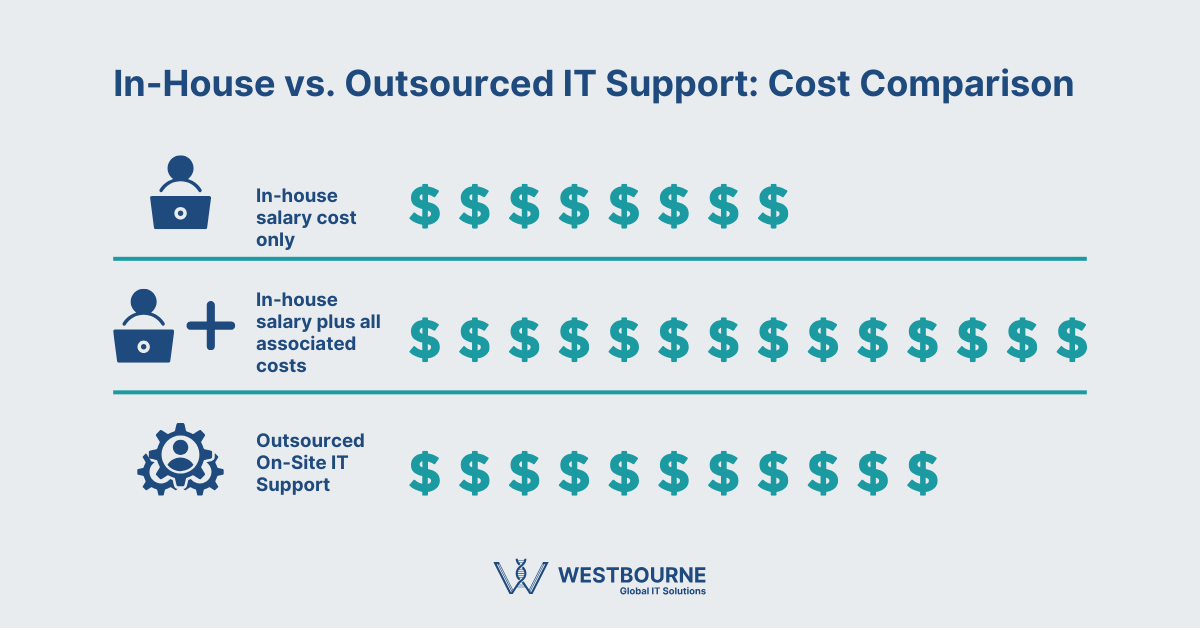
Often, however, there are “hidden” costs when recruiting in-house, i.e., costs that are not always accounted for when comparing the two options. Not accounting for these hidden costs skews the equation when assessing which is more cost-effective – recruiting in-house or outsourcing.
In summary, comparing the salary of an in-house engineer with the cost of an outsourced on-site IT support contract covers the outsourced side of the equation but greatly underestimates the costs of in-house recruitment.
Even adding in the cost of recruitment (job listing sites, recruitment agencies, internal HR time, etc) doesn’t fully address the cost of recruiting IT talent in-house. This is because you also have to take into account other costs, including training, management overhead, escalation costs, continuity risks, and payroll costs on top of annual salaries.
Cost Analysis: Direct Hire vs. Outsourced On-Site IT Support
| Cost Category | Direct Hire (Recruit In-House) | On-Site IT Support |
|---|---|---|
| Acquisition | High: Job website/LinkedIn fees, internal HR time, technical vetting, recruitment agency costs. | Zero: Responsibility of the outsourced IT support provider. |
| Training & Certification | Medium: You pay for courses, exams, and downtime. | Zero: Covered by the outsourced IT support provider. |
| Management Overhead | High: A manager, often a non-technical manager, will need to oversee the technical role. | Minimal: The outsourced IT support provider is responsible for most management requirements. |
| Problem Escalation | High-to-Very High: If the engineer can’t resolve the problem, you will need to bring in external expertise. | Zero: The on-site engineer can call-in tier 3-level engineers and architects from their team. |
| Payroll | Medium-to-High: Employer social contributions, holiday pay, sickness pay, statutory pay. | Zero: Covered by the outsourced IT support provider. |
| Continuity Risk | High-to-Very High: Single point of failure scenario where additional costs are incurred when the in-house resource is off or leaves the company. | Managed: The outsourced IT support provider will have backup and contingency plans to ensure continuous service delivery. |
| Tools and Software | Medium-to-High: You will need to purchase the equipment and software needed by the engineer. | Zero: Covered within the outsourced provider's tech stack. |
When all the costs are included – both obvious costs and hidden costs – the balance of the financial equation looks a lot different. In fact, the actual cost of recruiting in-house IT resources is 40% to 75% more than the engineer’s annual salary.
When the real, additional costs are factored in, the annual, fixed-price contract for an on-site engineer often costs less than recruiting in-house. Plus, you get all the added benefits mentioned above – systems, processes, knowledge, continuity, fast escalation, etc.
The Verdict
Recruiting IT engineers in-house undoubtedly has benefits. But the downsides can be significant, from the risk of creating a single point of failure to the fact that the capabilities of the in-house resource will be limited to their individual skills and experience.
Outsourcing on-site IT support solves these challenges. Furthermore, with the right support, processes, and approach from the outsourced vendor, any downsides can be significantly mitigated.
Then there is the question of costs. That comes down to how you do the calculation. Compare salaries directly with the outsourced support costs, and the in-house option will be cheaper. Add on the real costs of recruiting in-house, and the outsourced solution becomes attractive from a cost perspective as well.
At Westbourne, we offer cost-effective, expert, scalable, and flexible on-site IT support. This is backed by over 30 years of experience and proven systems and processes. Get in touch to find out how we can augment your technical team with outsourced on-site IT support.
Latest Insights
Press Release: Clinisys and Westbourne Partner to Expand Laboratory Informatics Services Across Life Sciences Markets
TUCSON, AZ, USA / CORK, Ireland – September 7, 2026 Clinisys, a global leader in laboratory informatics solutions, and Westbourne, a life sciences-focused IT services company, are pleased to announce a strategic referral partnership designed to expand access to...
The Case for Partnership Over Headcount in Pharma Resourcing
In pharmaceutical laboratories, resourcing is a recurring issue (and headache). You might need a validation engineer,...
Does CSA Cover AI? What the FDA’s Guidance Means for AI/ML Tools in GxP Environments
Does CSA cover AI? The quick and simple answer to that question is yes. The final guidance from the FDA on Computer...
From CSV to CSA: A Complete Guide to Risk-Based Validation for Pharmaceutical and Laboratory Systems
CSA (Computer Software Assurance) is now FDA policy, so it now represents the risk-based methodology through which CSV...
Assessing and Controlling the Risks of AI in Pharmaceutical Operations
There is a lot of hype and hyperbole around AI, including the potential of AI in the pharmaceutical industry. However,...