
Does CSA Cover AI? What the FDA’s Guidance Means for AI/ML Tools in GxP Environments

Does CSA cover AI? The quick and simple answer to that question is yes. The final guidance from the FDA on Computer Software Assurance was published in February 2026. That guidance explicitly states that CSA applies to automation tools, data analytic tools, AI/ML (machine learning) tools, and cloud computing.
This explicit mention of AI and ML tools was not included in CSA guidance from 2022, so its inclusion now is significant.
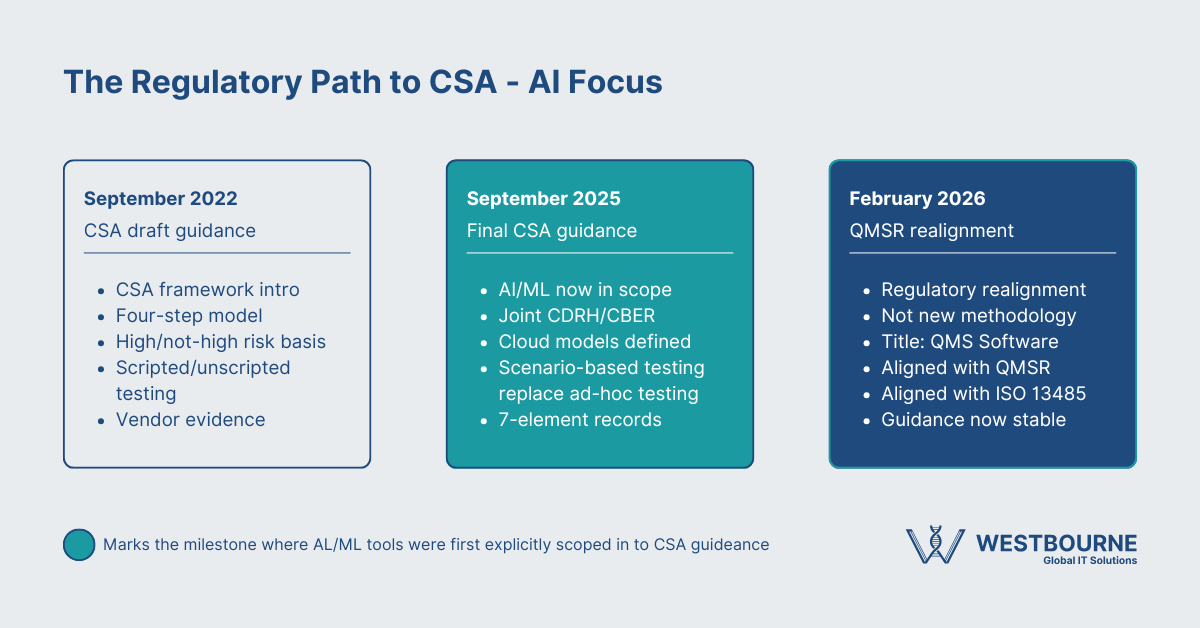
But that significance should be viewed as a scope clarification. It’s not a green light to unleash AI bots in your GxP environment. Instead, the FDA is saying that if AI technologies are used, CSA is an appropriate validation method.
The reality is that a technology category being mentioned in an FDA guidance document is not the same as an application of that technology being validated, deployed, or even advisable within pharmaceutical manufacturing or laboratory environments.
That said, it is important to know where the pharmaceutical industry stands in relation to the validation of AI in GxP environments. That’s what we will explore in this blog.
For more information on CSA in general, read our comprehensive guide – click here.
What Being “In Scope” Actually Means
As AI and ML technologies are now explicitly within the scope of CSA, they are subject to the same risk-based assurance obligations as any other software tool. Exactly the same.
Importantly, and as with all CSV and CSA guidance, there are no instructions on how to validate AI or any other technology. The guidance is a framework to work within, but the actual path to validation is up to pharmaceutical companies.
So, AI now being within the scope of CSA clarifies regulatory responsibility. It does not, however, mean anything in relation to the technical feasibility of validating AI technologies in the real world. The published CSA guidance sets the evidentiary bar but says nothing about whether AI technologies can meet it.
Why AI Validation Remains Genuinely Difficult
If a failure of an AI technology could compromise product quality or patient safety, validating it will be genuinely difficult.
Software tools and functions that could compromise product quality or patient safety must go through rigorous scripted/hybrid assurance processes. This is where the characteristics of AI (in some cases, the characteristics that make them impressive) cause issues:
- Non-determinism – CSA testing approaches assume software behaves consistently. AI tools typically don’t behave consistently.
- Explainability gaps – CSA methodologies require documented rationale and conclusions. However, some AI technologies are not transparent about their reasoning, making it hard to demonstrate why an output is trustworthy.
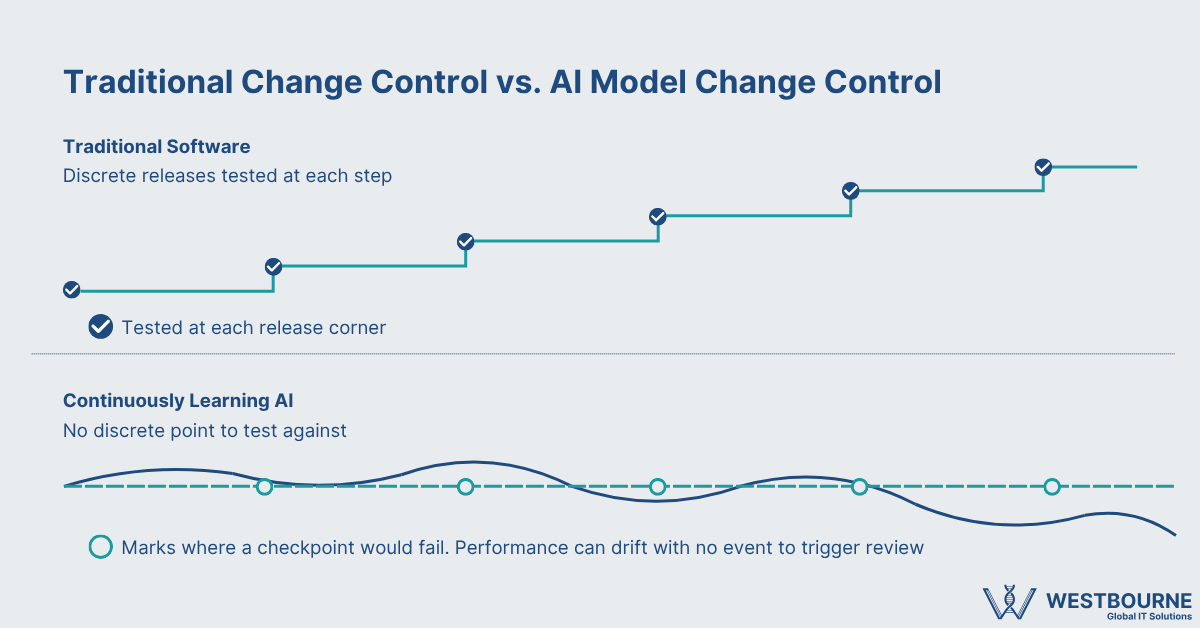
- Model drift – many AI tools can autonomously change after go-live, altering the risk profile. As changes can be autonomous, it is difficult to assess the altered risk profile at the point of change.
There are potentially ways of mitigating and dealing with the above challenges, but the important point is that the CSA guidance does not, and was not intended to, resolve them by itself.
The Unresolved Question – Validating Something That Keeps Learning
One of the key features of many AI models is that they continuously learn and improve. This isn’t always the case, of course, as AI technologies can also be developed using a fixed dataset before being frozen. This brings the AI technology into closer alignment with traditional software, potentially making validation more feasible.
However, the real power of AI more often than not comes from its ability to continuously learn. This is currently the biggest open gap when it comes to validating AI technologies in GxP environments. No clear guidance or best practice standards currently exist for AI technologies that keep on learning.
What This Means for Your Validation Program Today
Knowing where you stand is the most valuable outcome of the CSA’s guidance on AI technologies.
If AI tools are currently being discussed in your organization, formally or informally, you have a defined framework for an evaluation of validation feasibility.
If you are developing AI technologies, there is no workaround in CSA guidance for features just because they are AI-driven – the same validation requirements apply.
And whatever your position, it’s important to understand the situation, especially given how common it is today for software vendors to add AI-driven features.
With our experience at Westbourne, including experience with AI technologies, we believe caution should remain the right posture for pharmaceutical manufacturing and laboratory environments.
To find out more about how CSA applies to your systems, we’d be happy to help.
Latest Insights

The Case for Partnership Over Headcount in Pharma Resourcing
In pharmaceutical laboratories, resourcing is a recurring issue (and headache). You might need a validation engineer, lab-specific IT support, a CSV (computer system validation) specialist, or Quality Assurance support, but the traditional recruitment approach is both...
From CSV to CSA: A Complete Guide to Risk-Based Validation for Pharmaceutical and Laboratory Systems
CSA (Computer Software Assurance) is now FDA policy, so it now represents the risk-based methodology through which CSV...
Assessing and Controlling the Risks of AI in Pharmaceutical Operations
There is a lot of hype and hyperbole around AI, including the potential of AI in the pharmaceutical industry. However,...
Blended IT, OT, and Scientific Expertise – a Unique Value Proposition
Laboratory operations in life sciences sector companies require support from specialist vendors at various times and...
The Benefits of Pharmaceutical Digital Transformation
Digital transformation in the pharmaceutical industry involves integrating laboratory and manufacturing systems,...