
What is CQV? A Practical Overview for Pharmaceutical and Laboratory Teams
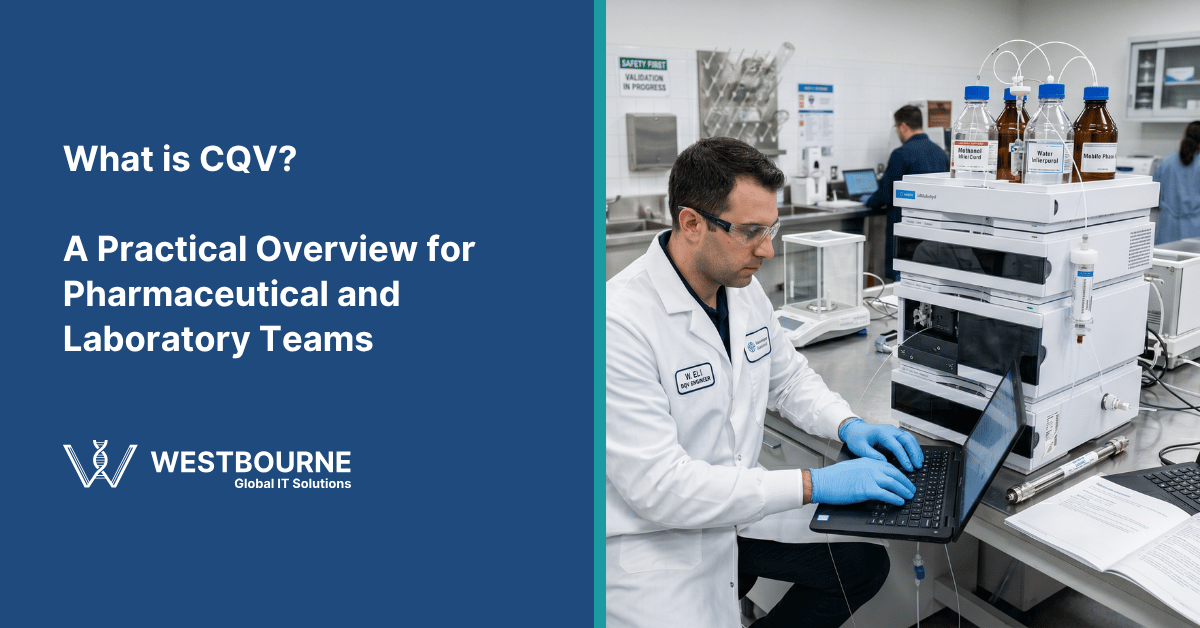
CQV (Commissioning, Qualification, and Validation) is a structured process that confirms that equipment, systems, and facilities are fit for use before being relied on in GMP-critical environments.
In pharmaceutical labs, for example, it involves verifying that laboratory instruments, analytical equipment, and the supporting lab infrastructure are properly installed, functioning as intended, and fit for use before they are relied on for GMP testing.
CQV processes are necessary for compliance, but they should also be viewed as a risk reduction activity, i.e., catching laboratory instrument or environment issues before they impact analytical results or data integrity.
One of the issues with CQV is that the terminology (commissioning, qualification, and validation) can feel like overlapping processes. We’ll untangle each element in this blog with a specific emphasis on our main area of expertise – pharmaceutical laboratory environments.
What Does CQV Cover in a Lab Setting?
In pharmaceutical laboratories, CQV covers:
- Analytical instruments, including HPLCs (high-performance liquid chromatography), GC (gas chromatography), balances, and spectrophotometers.
- Environmental monitoring equipment.
- Incubators and stability chambers.
- Autoclaves.
- Supporting utilities essential in laboratories, such as purified water, lab gases, and HVAC systems in controlled environments.
CQV is most relevant in pharma labs when new equipment or instruments are purchased. It is also relevant during laboratory relocations and when equipment is replaced or upgraded. Periodic requalification and calibration can also apply, depending on the instrument/equipment and its lifecycle.
It’s also important to note that CQV is distinct from method validation. CQV applies to the above, while method validation confirms the analytical method itself performs as intended, i.e., CQV involves the equipment, while method validation is about the method.
Commissioning, Qualification, and Validation Explained
Commissioning
Commissioning is the installation and initial functional checks of the laboratory equipment. For example, the installation checks of a new HPLC system. Commissioning is often vendor-supported in pharma lab environments.
Qualification
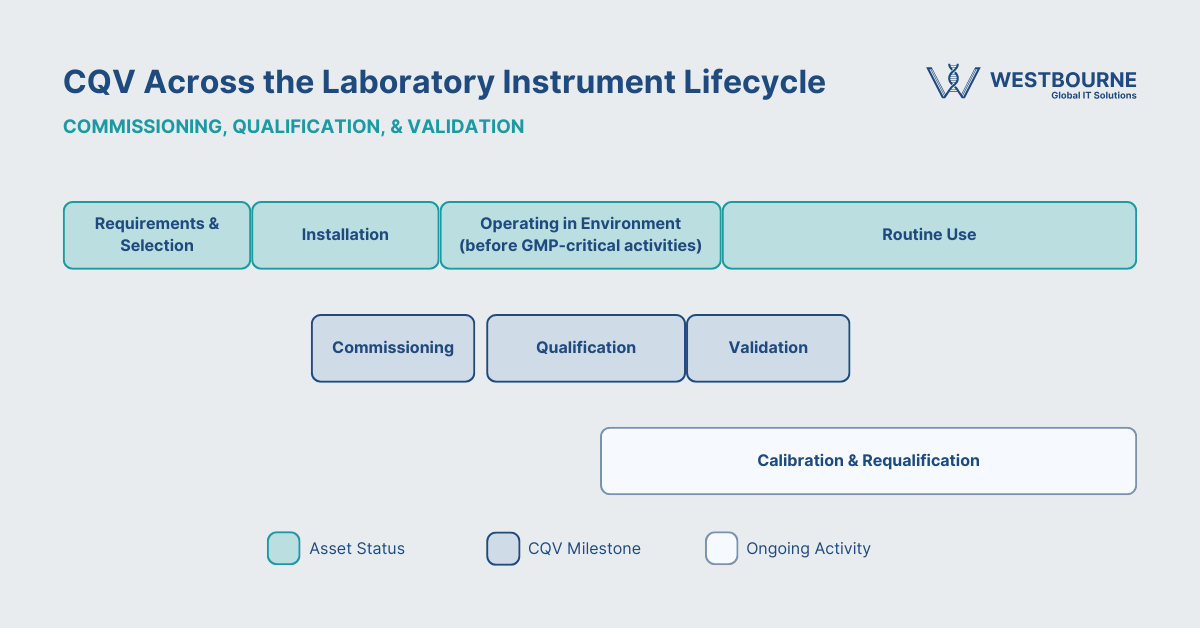
There are four main stages of qualification in pharma laboratories. Except for design qualification, they take place after installation, so the instrument/equipment is operating within the working lab environment, but before it goes into routine use.
- Design qualification (DQ) – does the instrument/equipment meet the requirements of the laboratory?
- Installation qualification (IQ) – has the instrument/equipment been correctly installed and configured?
- Operational qualification (OQ) – does the instrument/equipment perform according to the manufacturer’s specification?
- Performance qualification (PQ) – does the instrument/equipment perform consistently in real-world laboratory conditions?
In terms of qualification, it’s important to highlight that not all instruments/equipment need the same depth and detail of qualification. A risk-based approach is recommended.
Validation
Validation is the final stage in the process. It confirms that the qualified instrument/equipment produces results that are reliable and reproducible when used as part of an analytical method.
Where CQV Fits in an Instrument’s Lifecycle
CQV, CSV, and CSA – Related but Distinct
CQV and CSV/CSA are related but distinct processes. As mentioned above, CQV concerns physical instruments and equipment in laboratory environments. CSV (Computer System Validation) and CSA (Computer Software Assurance) cover the software systems that control the instrument/equipment and/or record data from the instrument/equipment.
For most instruments and equipment in pharma labs, the two, CQV and CSV/CSA, run together (CSA is a GAMP5-aligned risk-based approach to CSV – read our guide on CSV and CSA). For example, an HPLC qualified under CQV will have software (such as CDS – chromatography data system – software) that is validated under CSV.
While they are focused on different elements, both emphasize risk-based thinking, i.e., focusing qualification or validation effort where it is most important, rather than treating every instrument or system the same.
A Risk-Based Approach to CQV
It is worth highlighting further the risk-based approach to CQV. This is because older methods are more document-heavy, where documentation is recreated, and all instruments/equipment are treated the same.
With a risk-based approach to CQV, the level of qualification effort is based on risk. This means focusing the greatest amount of qualification effort on the instruments/equipment that have the most direct and substantial impact on data quality and product release systems. This approach aligns with the ISPE’s Baseline Guide on Commissioning and Qualification.
Also, vendor documentation can be utilised rather than spending time recreating something that already exists.
Given the recommended risk-based approach to CQV, it is highly beneficial to include QA, lab management, and instrument operators early in the process to accurately determine the qualification requirements.
Getting CQV Right in the Lab
CQV best practices in pharmaceutical laboratories include:
- Involve QA early when planning new instrument installations, upgrades, and replacements.
- Document as you go, as attempting to retrofit documentation is a common cause of delay.
- Keep CQV records organized and accessible.
- Treat CQV and CSV/CSA as complementary risk-based exercises rather than separate compliance burdens.
Finally, for expert CQV – and CSV/CSA – support, get in touch with Westbourne. Our CQV engineers will ensure efficient and successful CQV scoping and/or delivery programs.
Latest Insights

Assessing and Controlling the Risks of AI in Pharmaceutical Operations
There is a lot of hype and hyperbole around AI, including the potential of AI in the pharmaceutical industry. However, the reality of pharmaceutical manufacturing and quality control is that a single validation failure can halt a production line, trigger a regulatory...
The Benefits of Pharmaceutical Digital Transformation
Digital transformation in the pharmaceutical industry involves integrating laboratory and manufacturing systems,...
PODCAST: The Importance of Roadmaps to Digital Transformation Success in the Pharmaceutical Industry
In this episode of the Westbourne podcast, David Tucker, IT Program Manager at Westbourne, explains the critical role...
Pharma Lab IT and Digital Transformation Trends for 2026
Pharmaceutical laboratories continuously evolve to improve operational efficiency, address challenges, respond to...
Efficient and Cost-Effective Computer System Validation – Here’s How
Validating computer systems (software, equipment, or IT Infrastructure) is necessary in pharmaceutical facilities to...