
Chromatography Data Systems
Improve chromatography processes and maximize your CDS investment
Our team can help with all your Empower CDS requirements including resolving errors, automating processes, maintaining audit readiness, and ensuring your Empower CDS platform is compliant and fully optimized. Our Empower knowledge and experience can also be adapted to other CDS (chromatography data system) platforms to support your requirements.
Chromatography Data System Expertise
Transform chromatography data processes in your laboratory with our Chromatography Data System (CDS) and Empower CDS solutions. We provide a full range of CDS services, our engineers are Empower CDS experts, and we have experience in chromatography data processes and how to optimize them.
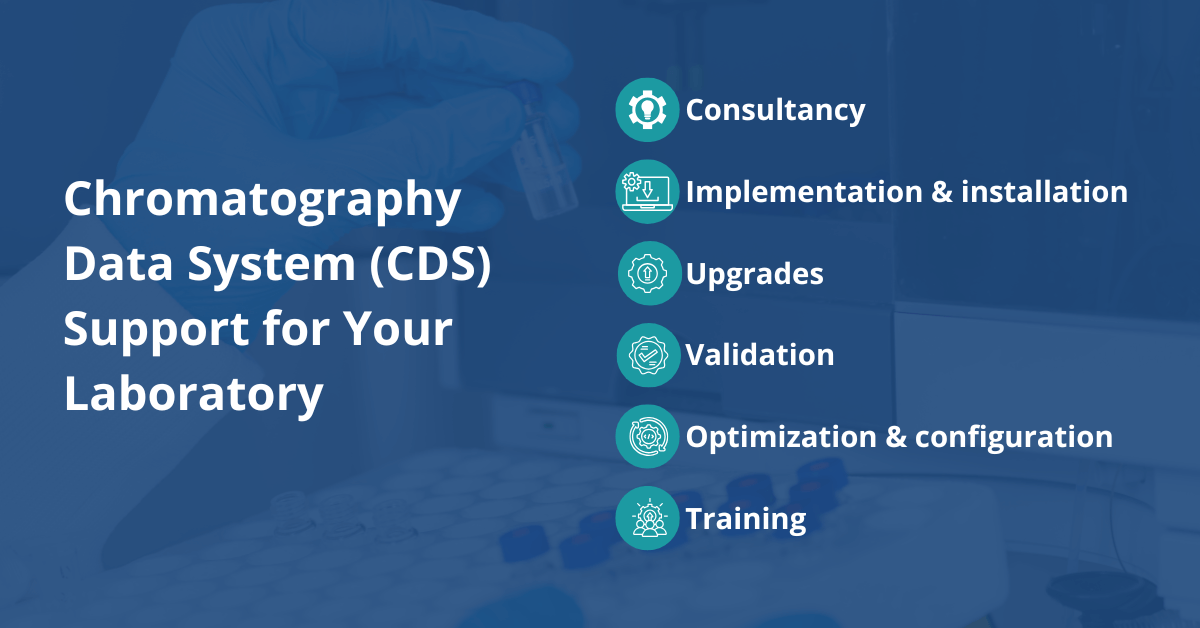
Our CDS expertise includes:
- CDS consultancy – getting an understanding of your requirements and recommending the best chromatography data system solution for your laboratory.
- Empower CDS implementation – configuring, installing, testing, and validating new Empower CDS implementations.
- Empower CDS upgrades – assessing and mitigating the risks of upgrading your Empower CDS platform to the latest version, completing the technical aspects of the upgrade, and validating the upgraded installation.
- Validation of your CDS – if your Empower CDS has not been properly validated, we will complete the process to bring your laboratory up to the necessary level of compliance.
- Empower CDS optimization and configuration – our engineers will review your CDS and chromatography processes to identify and implement improvements and optimizations with a focus on increasing productivity, minimizing the risk of human error, and improving the quality of data.
- Training – we’ll provide customized, engineer-led training to raise skill and confidence levels in your team.
Tailored Support for Your Laboratory
- Resolving errors and problems, including instrument connectivity issues.
- Automating processes, including the creation of customized reports to eliminate the need for manual calculations. We can also eliminate manual transcription via automated processes.
- Creation and optimization of data projects, methods, electronic signatures, etc.
- Integration with other systems, including LIMS platforms.
- Ensuring audit readiness with reviews of chromatography, audit trail, documentation, user accounts/privileges, and data integrity.
- Minimize downtime through proactive maintenance, system optimization, and staff training.
- Increasing skills levels, CDS platform usage, and system confidence through training.
Discuss Your Requirements
Transforming Chromatography Data Processes
- Reduce CDS downtime
- Improve staff skills
- Automate processes
- Improve productivity
- Eliminate the risk of human error
- Improve data integrity
- Optimise your CDS investment through maximum functionality use
- Improve adherence to testing and release schedules
- Ensure ongoing audit readiness
- Reduce chromatography data processing costs
Waters Empower CDS Training
As specialists in the Waters Empower CDS platform, we can provide expert training whatever your requirements. Our training solutions are fully customized to ensure you get a package that meets your needs today while improving your laboratory processes for the future.
The training will be provided by Empower CDS experts with experience enhancing the skills and confidence of laboratory teams. We can also provide any level of training that you need, from starter training and refresher training to intermediate and advanced training to training for developers on the management and configuration of the Empower CDS platform.
Technology & Quality Support Solutions FAQs
What does maintaining a validated state mean in practice for a QA or QC laboratory?
Maintaining a validated state means ensuring that laboratory systems such as instruments, software, and connected platforms remain compliant and operate within their validated parameters on an ongoing basis.
In practice, this involves managing system changes through a controlled process, conducting periodic reviews, maintaining audit trails, and ensuring that any upgrades or patches are assessed and documented before deployment. Westbourne provides the engineering resource and operational processes to sustain this across QC and QA environments on an ongoing basis, including through system changes and software lifecycle events.
Can Westbourne support both the validation and the day-to-day operational support of laboratory informatics platforms?
Yes. Westbourne provides support across the full lifecycle of laboratory informatics platforms, including LIMS, CDS, ELN, and SDMS. This covers initial implementation and validation, integration with instruments and other systems, ongoing L1–L3 operational support, and managing changes and upgrades within a validated environment. Where required, support can be delivered on-site, remotely, or as a combination of both. Support can also be structured as a project-based engagement or as part of a longer-term managed service.
How does Westbourne's support differ from a standard IT managed service?
A standard IT managed service is typically focused on infrastructure. Examples include networks, endpoints, and general application support. Westbourne's service is designed specifically for regulated laboratory and pharmaceutical manufacturing environments, where IT support must account for GxP compliance requirements, data integrity obligations, and the operational characteristics of scientific instruments and systems.
Westbourne engineers working in laboratory environments have both technical and scientific competency. This is essential to operate safely and effectively alongside QC and QA teams. Our combination of IT, OT, and quality knowledge is not typical of general managed service providers.
What is the difference between Computer System Validation (CSV) and Computer Software Assurance (CSA)?
CSV is the traditional approach to validating computer systems in regulated pharmaceutical environments. It is documentation-heavy and prescriptive, requiring detailed records at each stage of the validation lifecycle.
CSA, introduced by the FDA as a preferred alternative, takes a risk-based approach. This involves concentrating validation effort and documentation on systems and functions that present the greatest risk to patient safety and product quality.
For lower-risk systems and functions, the documentation burden is reduced significantly. The outcome is a more efficient process that still meets regulatory requirements. Westbourne applies both approaches, selecting the appropriate methodology based on the system type, its intended use, and the applicable regulatory framework.
Does Westbourne provide support for 24/7 laboratory operations?
Yes. Westbourne offers follow-the-sun coverage for IT and mission-critical laboratory systems, including incident, change, and problem management within validated environments. This is structured to meet the operational demands of facilities that require continuous availability, with defined escalation paths and service delivery governance. Coverage models are agreed during the scoping phase and can be adjusted to reflect the specific criticality of the systems in scope.
What is inspection readiness and why does it require ongoing effort?
Inspection readiness refers to the state of being prepared to demonstrate compliance to a regulatory authority such as the FDA or EMA during an unannounced or scheduled inspection. It is not a one-time exercise. Instead, laboratory systems generate audit trails continuously, SOPs must remain current, and any deviations or changes must be documented and justified. A lapse in any of these areas can result in observations or findings during an inspection.
Maintaining inspection readiness requires a combination of robust processes, disciplined change control, regular internal reviews, and sufficient resourcing, all of which form part of Westbourne's QA and QC operational support.
Can Westbourne provide qualified personnel on a contingent or contract basis rather than as part of a managed service?
Yes. Westbourne can supply validation engineers, QA specialists, lab informatics professionals, and IT engineers as contingent workers to supplement your existing team. This model suits organizations that have a time-limited project requirement, a gap in internal resources, or a specific technical need that falls outside the day-to-day scope of their permanent staff. All personnel provided through this model are subject to the same training and competency standards as those working within Westbourne's managed service engagements.
Pharmaceutical Digital Transformation
Learn More >
Pharma Lab and Manufacturing
Learn More >
On-Site ICT
Learn More >
Validation
Learn More >
Global Service Desk
Learn More >
Latest Insights
Pharma Lab IT and Digital Transformation Trends for 2026
Pharmaceutical laboratories continuously evolve to improve operational efficiency, address challenges, respond to demand, and remain competitive. As 2025 draws to a close, what areas are we likely to see prioritized over the coming year and beyond? In this blog, we...
Empower 3 Audit Trails and Logs Explained
In the context of the computerized systems used in GxP environments, audit trails are a chronological record that...
17 Features You Need in a Global Service Desk
In today's digitally connected world, a global service desk is more than just a support function. It’s the backbone of...
Why Multidisciplinary Skills Are Essential in Pharma Lab and Manufacturing Operations
Very specific skills are required to successfully, safely, and profitably run a pharmaceutical manufacturing and...
How On-Site IT Engineers Become Enablers in Your Organisation
There are many technical issues and tasks that can be supported by remote teams. Others, however, require the physical...